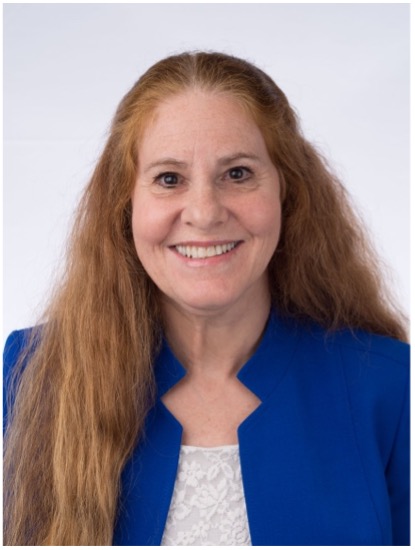
Candidate nominated by the Nominating CommitteeUUA Board of Trustees Position 5
Terry GrimImagine the future boldly, care deeply for one another, and act courageously for justice.
Professional futurist, internationally experienced lay leader, and
committed Unitarian Universalist for more than three decades,
Terry is known for her collaborative spirit, her integrity, and
her ability to bring out the best in others. She encourages
people to think bigger, plan cooperatively, and move forward
together with purpose and care. Her life and service reflect
thoughtful leadership, steady values, and enduring devotion to
meeting this moment for the future of our faith.
Vote at UUA General Assembly 2026
Helping Unitarian Universalism navigate change, grounded in our values and prepared for what’s next.
From the candidate
In Terry's words.
I am honored to be recommended by the Nominating Committee to
serve as a Trustee on the UUA Board of Directors.
Growing up in diverse communities across multiple countries, I
experienced firsthand the deep interconnectedness of life and
the many ways people live and believe. Those early experiences
shaped my enduring commitment to the dignity and worth of every
person and led me to Unitarian Universalism, where I found a
true spiritual home.
For thirty-four years as a member of Bay Area Unitarian
Universalist Church, I have served in a wide range of leadership
roles, including President, Vice President, and Treasurer of
the Board, and chair of numerous committees and teams. I remain actively
engaged as a Worship Associate, choir member, mentor, and
participant in ministries and social justice efforts.
My professional path reflects a lifelong focus on understanding
change and helping organizations navigate it. With academic
grounding in computer science, future studies, and
organizational psychology, I spent thirty years at IBM in
strategic, management, and technical roles. I later taught
Foresight at the University of Houston and founded a consulting
practice serving associations and organizations. I have also
served on the Board of the Association of Professional
Futurists and chaired the development of its Code of Ethics.
Across all of my work, I have been committed to creating
inclusive environments where diverse voices are heard and
valued, because both organizations and communities are stronger
when everyone can participate fully.
I believe our faith calls us to imagine the future boldly, care
deeply for one another, and act courageously for justice. I am
inspired by the opportunity to help the UUA meet this moment,
bringing my deep love for our faith, my ability to connect
across difference, and my training and experience helping
people come together to envision and build a better future.
— Terry Grim
In Terry's words
What I bring.
A futures and foresight perspective.
My professional background in engineering, systems thinking,
futures, and organizational psychology has shaped how I
approach leadership and institutional change. I believe
futures thinking is not about predicting what will happen,
but about helping organizations ask better questions,
recognize emerging challenges, and prepare thoughtfully for
a changing world while staying grounded in our values.
A Texas and Southern perspective.
Having lived in Texas since 1983, I understand both the
opportunities and challenges of building UU community in
regions where Unitarian Universalism is not culturally
dominant. Congregations in the South often learn resilience,
adaptability, hospitality, and relationship-building in
unique ways. I believe these experiences have something
important to contribute to the broader UU movement.
Experience in leadership and service.
Over many years, I have served in a wide range of leadership
and volunteer roles within my congregation and beyond. I
value collaborative leadership, practical problem-solving,
and the steady work of supporting healthy institutions. I
believe leadership is not only about vision, but also about
showing up consistently, listening carefully, and helping
communities navigate complexity together.
A deep commitment to UU values.
My commitment to Unitarian Universalism is rooted not in
ideology, but in lived practice: community, compassion,
reflection, service, and respect for human dignity. I
believe our values call us both to care for one another and
to engage courageously with the challenges of our time.
Background
The shape of a life and a career.
Just the Facts
Click any slice to see what it holds.
Places Called Home
Born in Tokyo, Japan
Grew up living in Germany, Hawaii, Laos, Belgium, and Brazil
Graduated from high school in Rio de Janeiro, Brazil
As an adult, has lived in Virginia, Florida, Massachusetts, Texas, and England
Education
B.S. in Computer Science with High Honors, University of Florida (1975)
M.S. in Studies of the Future with Honors, University of Houston (1995)
M.A. in Industrial-Organizational Psychology with Honors, University of Houston (2014)
A career focused on technology, strategy, leadership, and helping organizations think about the future.
IBM (1976–2006)
Computer Engineer supporting the Space Program
Senior Manager for Ground Software, IBM Space Station Program
International assignment to the United Kingdom managing a BT project
Business Development Manager for the Clear Lake site
Corporate Strategy, Armonk, New York
Division Strategy staff role supporting the Vice President of Global Services
Project Executive
Other Professional Experience
Mitre Corporation (1975–1976)
Social Technologies (2006–2009)
Adjunct Professor, Studies of the Future, University of Houston (2006–2019)
Founder and Partner, Foresight Alliance (2010–2022)
Family
Husband and life partner, Clif, for 50 years
Son Chris, his wife Lucy, and grand puppy Maddie, who live in Petaluma, California (and yes, he built this website)
Rosy, an adorable gray tuxedo cat
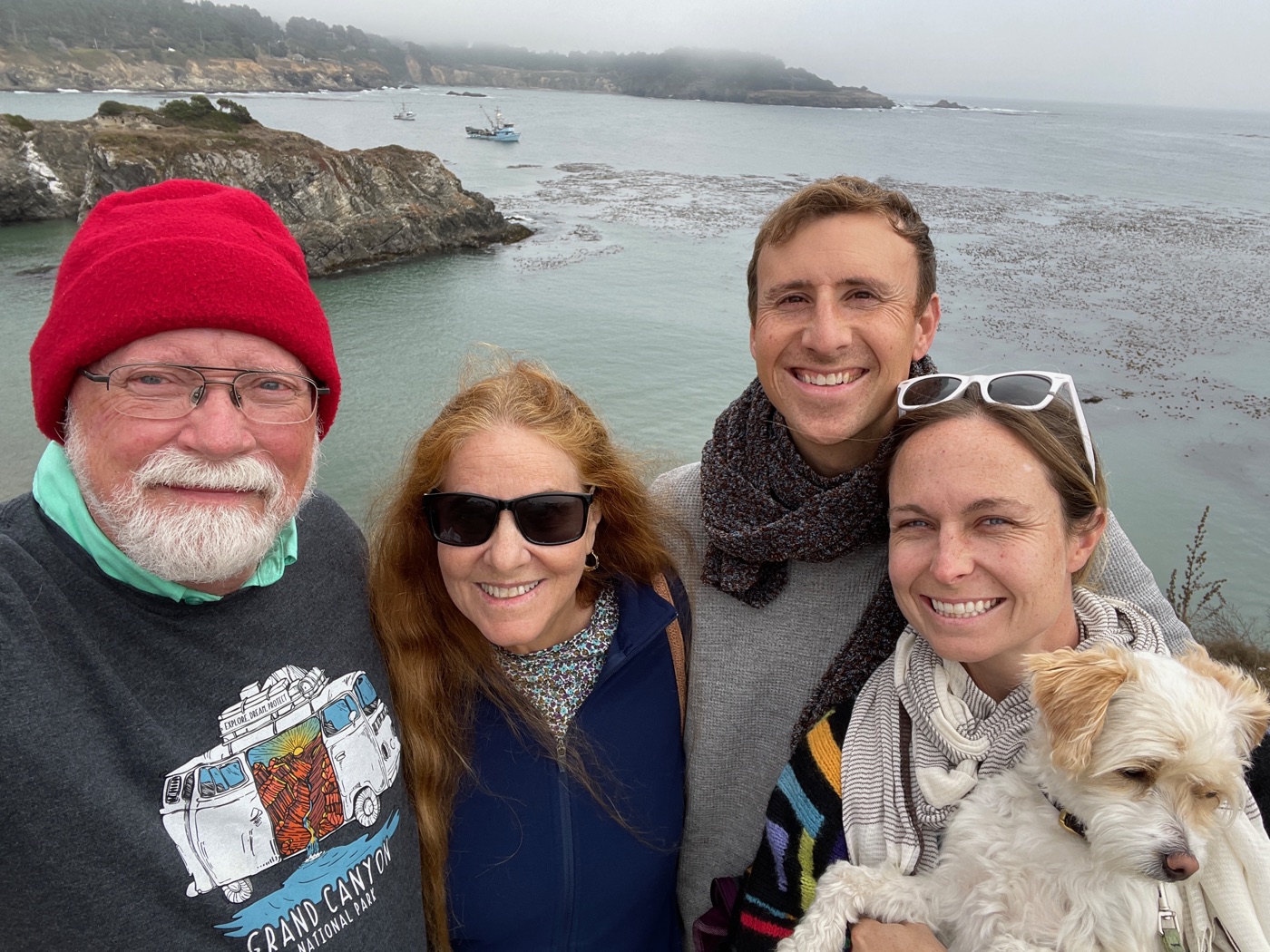
The four of us in California.
Spirituality
My parents were raised Jewish, but because of family differences we were exposed to many different religions and churches while growing up
I consider myself a panentheist and find awe, connection, and the sacred in nature and in all living things
Meditation and reflective practice
In earlier years it was long-distance running
These days it is time in the garden, weeding
Being a Unitarian Universalist has allowed me to bring the wholeness of my life together
Respect for many cultures, traditions, and ways of understanding the world
A deep sense of interconnectedness with people, nature, and all living things
A commitment to dignity, compassion, and inclusion
Interests
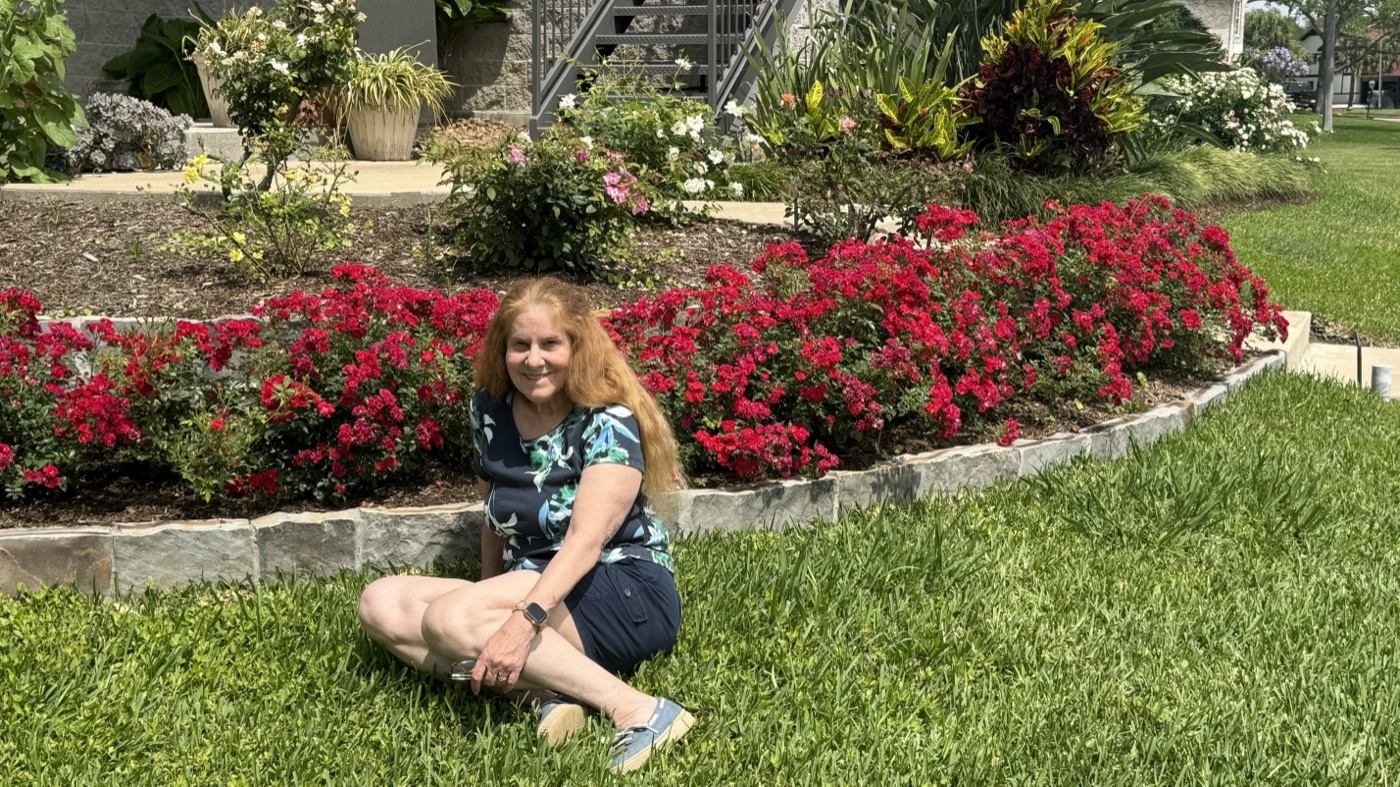
Terry in front of the pride of her spring flower beds this year: red drift roses.
Running, walking, and staying active
Completed 23 marathons
Ran a marathon on every continent
Traveling in our camper van around the country and enjoying the beauty of the landscape and parks
Gardening, reading, and choir
Theater, especially Houston’s professional and community theater scene
A Few Special Recognitions
NASA’s Silver Snoopy Award — astronaut-given honor recognizing exceptional contributions to mission safety and success
Received an American flag that flew aboard a Space Shuttle mission
Awarded “Most Important Futures Work” by the Association of Professional Futurists for development of the Foresight Maturity Model
Service
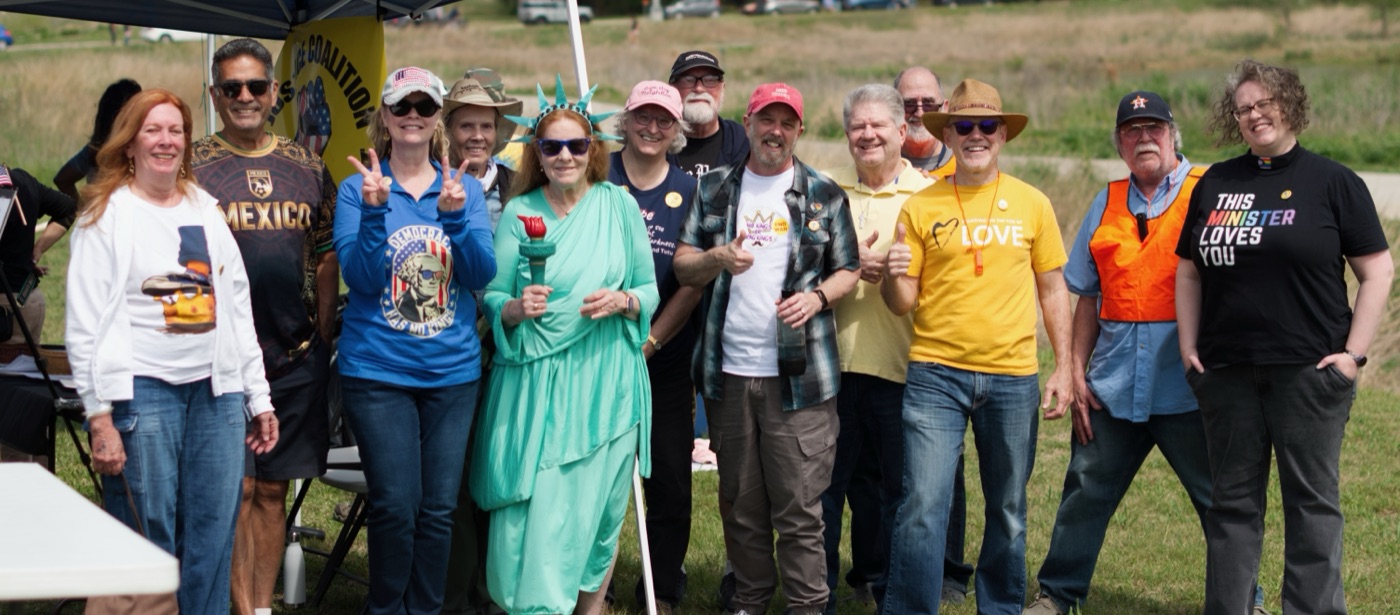
Terry as Lady Liberty with the Justice Coalition team at No Kings 3 rally.
Bay Area Unitarian Universalist Church: worship associate, social justice programs, nomination committee, pledge drives, fundraisers, workshops, special projects, and just general “raising my hand” when it’s needed
Association of Professional Futurists: Code of Ethics development, student mentoring, and awards review
Futures training and workshops for other UU Churches, Southwest Unitarian Women (SWUUW), and other UU gatherings
Community activities: Justice Coalition of Greater Clear Lake (marches, rallies, etc.), Christmas Reindeer Run, and community flower gardens
Why Futures, Why Now?
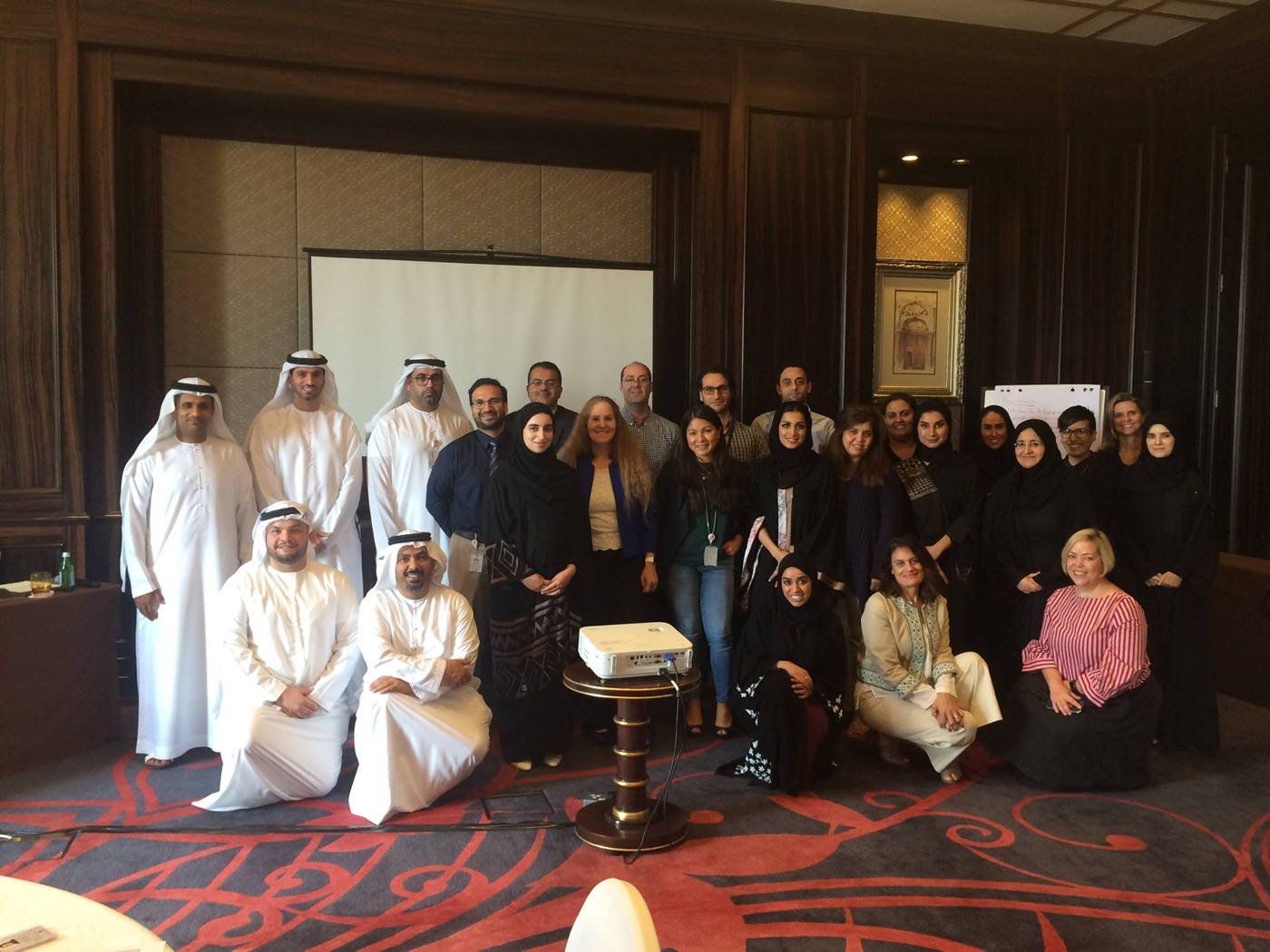
Terry teaching foresight methodology to students in Abu Dhabi for the Ministry of Culture of the UAE.
Futures is fundamentally about asking better questions and
expanding what we can see before we decide what to do.
There is a well-known idea often attributed to Albert Einstein:
that if he had an hour to solve a problem, he would spend most
of that time understanding the right question. Whether or not
he said it exactly that way, the insight is powerful. Better
questions lead to better understanding, and better
understanding leads to better decisions.
That is the heart of futures thinking.
Futures work explores what is possible, what is probable, and
what is preferable. Unitarian Universalism is especially strong
in the last of these — we are grounded in values that
help us imagine what we want the world to become.
But in practice, we can often move too quickly to preference
without fully exploring possibility and probability. We arrive
at answers before we have fully seen the landscape around them.
Futures asks us to look wider, deeper, and longer.
Looking wider means stepping outside our
immediate environment and paying attention to change happening
in other places and systems. Those shifts will shape us whether
we notice them or not.
Looking deeper means questioning assumptions.
If we already believe we know the answer, we risk repeating
patterns instead of learning from them. But when we allow
ourselves to look at where we are surprised, we begin to see
where our assumptions were incomplete or no longer valid.
Looking longer means thinking beyond immediate
outcomes — not just what works today, but what builds
resilience, coherence, and consequence over time. The future is
never simply “more of the same.” It is shaped by how
interactions and consequences unfold.
The Futures Toolkit and Why It Matters for Governance
Futures thinking is not only a way of seeing. It is also a way
of working.
One of the gaps in many institutions is that we often encourage
people to “think outside the box,” but we do not
always give them the tools to do it in a disciplined or shared
way.
A futures toolkit provides those methods. It helps groups
surface assumptions, notice weak signals of change, explore
multiple possible futures, and test decisions against more than
a single expected outcome.
At its best, it creates a shared language for uncertainty so
that complexity becomes something we can work with, rather than
something we rush to simplify.
In a governance setting like the UUA Board, this is especially
important. Board members are constantly making decisions that
sit at the intersection of values, institutions, and an
evolving external world. Futures tools do not replace wisdom or
experience — they strengthen them by making sure
decisions are informed by a broader field of possibility and
consequence.
They help ensure we are not only responding to what is already
visible, but also preparing for what is emerging.
Futures is not about predicting what will happen. It is about
understanding multiple possible futures and working to influence
them in the direction we care about.
Good futures work is not judged by whether it is
“right.” It is judged by whether it helps us make
better decisions in the present. Sometimes we want a forecast
to be wrong — we are trying to influence the outcome to
not happen (like most of our climate forecasts).
This is why we say futures, not future. It is
always plural. There is never just one path ahead, only a set
of possibilities we are constantly moving through and shaping
together.
Right now, that matters. Unitarian Universalism is navigating
complexity, change, and uncertainty. In moments like this, it
is easy to narrow our focus and move quickly to familiar
answers. Futures thinking offers something different: the
discipline to slow down just enough to see more clearly, and
then move forward with greater intention.
It is not a replacement for our values. It is a way of engaging
them more fully by making sure we are asking the right
questions before we decide what comes next.
Endorsements
What people are saying about Terry.
Community leaders and colleagues alike point to Terry’s rare
ability to build trust, encourage participation, and include
diverse voices…
“
One of my longtime best friends and one of the finest
people I know — a great futurist, a gifted teacher,
a successful manager…the reason my wife and I are
Unitarian Universalists.
Read full statementShow less
I was amazed when the minister of our church in
Sacramento asked if I knew Terry Grim. We came to
Sacramento from Houston. She’s a futurist;
I’m a futurist. In fact, I was lucky enough to be
her teacher when she received her Master’s degree
in Studies of the Future there.
He found out that she was running for the UUA Board.
Know her? Only one of my longtime best friends and one
of the finest people I know — a great futurist, a
gifted teacher, a successful manager.
But I have one connection with Terry that few others
have. She is the reason (indirectly) that my wife and I
are Unitarian Universalists and delighted to be so.
We were spending a weekend in Santa Rosa, CA. We were
going for a walk on Sunday morning, but it was raining.
I said, “Why don’t we go to church?”
Neither of us had been part of a church in 50 years. I
looked up the UU church there because Terry had invited
me to give a short talk on the future at her church in
Houston many years ago. We found it, attended the
service, and joined the church in Sacramento the next
weekend.
You will be lucky and immensely grateful to have Terry
contributing her skill and her spirit to this marvelous
community.
“
She is funny and kind, so working with her is truly
joyful…She not only brings her own expertise
and perspectives to the Board of Trustees—she
will empower and inspire the entire Board.
Read full statementShow less
I am delighted to endorse Terry Grim for the UUA
Board of Trustees, and not only because I am her
minister. Every group project has a person who shows
up with most of the hard parts already done –
that’s Terry. She then offers that work as an
invitation to collaboration, prompting others to do
the deep thinking needed to bring out their best
ideas and contributions.
Her work as a futurist has taught her how to ask the
right questions, well before trying to come up with
answers. She brings flexible and adaptive thinking
to all that she does. Moreover, she is funny and
kind, so working with her is truly joyful. When I
find myself wondering how best to approach problems
in congregational life, Terry is often my first
phone call. She not only brings her own expertise
and perspectives to the Board of Trustees—she
will empower and inspire the entire Board.
“
Given all the challenge and opportunity that lies
ahead, the UUA Nominating Committee felt Terry was
the best choice for position #5 on the 2026 slate.
I couldn’t agree more.
Read full statementShow less
I first met Terry in 2009 when I began my
ministerial internship at the Bay Area Unitarian
Universalist Church, her home congregation in
Houston. Since then, I have appreciated the gifts
Terry has brought not only to her home congregation
and our faith, but the wider world as well. Terry
is a deeply faithful Unitarian Universalist who
cherishes our values and has served in nearly every
leadership role in her congregation. She is a
strategic thinker with a proven record of leading
organizations through times of challenge and onto
paths of new flourishing. Her election would also
bring much-needed geographical diversity and lay
perspective to the UUA Board.
Given all of the challenge and opportunity that
lies ahead, the UUA Nominating Committee felt Terry
was the best choice for position #5 on the 2026
slate. I couldn’t agree more.
“
She was instrumental in framing a process that
allowed the entire church community to create a
forward-thinking, inclusive and engaging path for
the coming years. I believe Terry is an ideal
candidate…
Read full statementShow less
I am grateful to have had the honor and pleasure of
serving as Terry’s minister for nine years.
Her commitment and leadership within the Bay Area
Unitarian Universalist Church in Houston is
extraordinary. Terry brings a unique ability to see
the broader vision while focussing on the work at
hand. During the congregation’s 50th
anniversary in 2017, her knowledge and experience
with Futurist studies played an important role.
She was instrumental in framing a process that
allowed the entire church community to create a
forward-thinking, inclusive and engaging path for
the coming years. I believe Terry is an ideal
candidate to serve on the Unitarian Universalist
Association’s Board and I enthusiastically
endorse her for this position.
“
Terry has assisted our minister and other lay
leaders of our church in addressing immediate
problems and in their planning for the future. She
is an invaluable member of our church and would be
a gift to the UUA Board.
Read full statementShow less
Terry was one of the first people I met at Bay Area
UU. She welcomed me immediately and eased my
anxiety in my first-time role as a Worship
Associate with this new congregation. That first
impression was cemented by every encounter I have
had with Terry since. She is a vibrant member of
our congregation: a member of the choir, the
Women’s Spirituality Group, a Worship
Associate on Sundays, a technical advisor for
services, and a leader in our Service and Justice
projects.
Terry is an accomplished professional and leader in
world-wide conferences of Futurists, and our
congregation is lucky to have her as an on-site
visionary. She led a visioning workshop for our
entire congregation a couple of years ago. The
results of that workshop were instrumental in our
planning when the church was gifted with an
unbelievably generous gift by a member. Terry has
assisted our minister and other lay leaders of our
church in addressing immediate problems and in
their planning for the future. She is an invaluable
member of our church and would be a gift to the UUA
Board.
“
Her wisdom and teaching inspired leaders to do
great work in their areas of impact.
Read full statementShow less
Terry Grim helped create a comprehensive foresight
program to equip association and nonprofit
executives to prepare their organizations for the
future. Thanks to her expertise and vision,
hundreds of board members and staff now have the
insight and processes to make future-informed
decisions. Her wisdom and teaching inspired leaders
to do great work in their areas of impact.
“
She has always been caring, considerate, and dedicated
to the work of this faith. She brings big-picture
thinking of where we are going and how we will get
there.
Read full statementShow less
Terry will make an excellent Board member. Her
futurist visioning considers all elements of community.
I grew up with her at the Bay Area Unitarian
Universalist Church. Even when I was little, she
always listened to what I had to say with the same
attention she would an adult. She has always been
caring, considerate, and dedicated to the work of
this faith. She brings big-picture thinking of where
we are going and how we will get there. She has
served on countless committees and our Board, and
she is ready to serve our larger faith.
“
Her caring approach to the students and teaching
led us to refer to her as the “mother”
of our program…Terry has that rare
combination of deep compassion and caring mixed
with a keen eye on how to make things happen.
Read full statementShow less
It is my great pleasure to endorse Terry Grim for
the national Unitarian Universalist Board. I have
known Terry since we were classmates in the
Foresight program in the 1980s. She has always
demonstrated an insatiable curiosity about the
future but balanced that with a practical
orientation that gets things done. Many years
later, I was thrilled to have Terry join our
foresight consultancy, Social Technologies, where
her expertise in strategy development from IBM was
a huge boost for our company.
We crossed paths once again at the University of
Houston where Terry taught the Introduction to
Foresight course for more than a decade. Her caring
approach to the students and teaching led us to
refer to her as the “mother” of our
program. She also brought methodological rigor,
including the development of an award-winning
evaluation tool, the Foresight Maturity Model, that
we still use in the program today. Terry has that
rare combination of deep compassion and caring
mixed with a keen eye on how to make things happen.
She will be a tremendous asset to your Board!
“
She is exactly what the Unitarian community needs
right now to ensure that we will continue to show
up everywhere we need to be, even as the world
changes around us.
Read full statementShow less
As a third-generation UU with family members who
have served on the national UUA board, I can
wholeheartedly endorse Terry Grim as a necessary
and brilliant addition to the UUA’s
leadership team.
As our nation endures a season of deep change, the
demands on religious institutions are changing,
too. The UUA’s future will require us to
elect leaders who can accurately assess the
church’s strengths, challenges, and
opportunities in this moment — and lead it
forward while staying firmly grounded in our
historic principles.
Terry enjoyed a long and successful career as a
professional futurist providing strategic foresight
to major corporations across the country, relying
on sound methodology and rigorous professional best
practices to guide them through times of challenge
and change. Hers is a rare skill set that will add
steady foresight to the board during this turbulent
era. She is exactly what the Unitarian community
needs right now to ensure that we will continue to
show up everywhere we need to be, even as the world
changes around us.
“
Her service on the nominating committee again
demonstrates her commitment to equity and
representation which is how she always shows up in
her many leadership roles in our church.
Read full statementShow less
Terry’s work as a member of the BAUUC
nominating committee has been very valuable, as she
has consistently filtered every decision through
Unitarian Universalist values while graciously but
firmly insisting on diversity and inclusion as we
developed our candidate slate. Her service on the
nominating committee again demonstrates her
commitment to equity and representation which is
how she always shows up in her many leadership
roles in our church. She walks the talk, and has
for many, many miles, and no doubt will for the
future of the UUA.
“
Good Lord! If you don’t by now have a
futurist on board you surely need one, and
Terry’s the one you need! …a friend I
value for her honesty, her strong abilities as a
foresight practitioner, her breadth of knowledge,
and her ability to bring together both people and
ideas, working sincerely with both.
Read full statementShow less
I’ve known Terry Grim for probably 20 years.
As a professional futurist myself since the early
1980s working nationally and internationally on
government, corporate, and association foresight
projects from Washington, DC, with Coates &
Jarratt, Inc., and as a founder member of our
professional association (Association of
Professional Futurists) I’ve had the
opportunity to work with and get to know Terry on
many occasions, currently as the leader of our APF
Ethics Committee.
It is my honor, and my delight, to endorse Terry
Grim for UUA Board of Directors. It has been my
fortunate experience to work with Terry as the
leader of our Ethics committee of our professional
foresight association (Association of Professional
Futurists) and to engage with her in the process of
designing and setting up an ethics structure suited
to the modern age. Terry is also a friend I value
for her honesty, her strong abilities as a
foresight practitioner, her breadth of knowledge,
and her ability to bring together both people and
ideas, working sincerely with both.
Good Lord, if you don’t by now have a
futurist on board you surely need one, and
Terry’s the one you need!
“
Her visioning workshops have…inspired innumerable
congregations and corporations…Her passion and
expertise are unparalleled and her willingness to serve
should be accepted without reservation.
Read full statementShow less
Having futurist Terry Grim on our national Board is a
no-brainer! Her visioning workshops have moved and
inspired innumerable congregations and corporations as
they strategized and implemented mission and growth
plans. I know her as a generous leader and teacher and
as a listener and consensus builder. She lives and
breathes Unitarian Universalist values and
justice-seeking. Her passion and expertise are
unparalleled and her willingness to serve should be
accepted without reservation.
“
Terry’s collaborative approach made her an
exceptional partner throughout the project. Her
contributions were instrumental in delivering
meaningful and forward-thinking insights.
Read full statementShow less
Terry Grim was a critical component in the success
of the ASAE ForesightWorks research project. Her
deep experience in foresight, combined with a
genuine willingness to understand the unique
dynamics of the association community, strengthened
the quality and relevance of the work. Terry’s
collaborative approach made her an exceptional
partner throughout the project. Her contributions
were instrumental in delivering meaningful and
forward-thinking insights.
I grew up all over the world and did not really live in the
United States until college. My childhood was shaped as much
by places as by people, by witnessing beauty, hardship,
contradiction, and resilience at an early age.
My father worked for the U.S. government, and while we
traveled widely, he earned a government salary that did not go
far supporting a family of six moving around the world. We
were a long way from wealthy. We lived in government housing
and didn’t have the ability to really own anything.
Still, even as a child, I understood that we carried a level
of safety and privilege that many around us did not. I did not
have the language for it then, but I could see it clearly.
Some of my earliest memories are from Laos during the Vietnam
War. I remember prisoners being paraded through town in bamboo
cages and people begging for food. I was young enough to be
mostly invisible, but old enough to absorb what I was seeing.
I remember visiting the home of a young woman who worked for
our family and seeing how differently she lived from us. But I
also remember the gentleness of the Buddhist culture around
us, the reverence for living things, even insects, and the
sense that compassion was not weakness but discipline.
In Brazil, I saw another kind of inequality. We drove through
favelas where poverty and desperation created real danger and
fear. I remember standing in line outside a movie theater,
where vendors walked through the crowd selling candy before
the movie. Children clustered around people asking for the
candy, not because they wanted sweets, but because they were
hungry. Those experiences stayed with me. They made suffering
personal and impossible to ignore.
When I came to the United States for college, I encountered
something new to me: open racism and sexism. I had grown up in
many cultures, but I had not yet seen discrimination woven so
deeply into systems and expectations.
At the same time, my own family was facing financial
realities. I was the oldest, and I had a brother close to me
in age. It was suggested that I attend junior college because,
as people said at the time, I would “just get married
anyway,” and the family’s financial help should go
to my brother.
I rebelled. But it meant putting myself through college with
loans and student jobs.
I enrolled at the University of Florida intending to become an
engineer. Despite years of math and science preparation, I was
told engineering was not realistic for me and that perhaps I
should become a math teacher instead. Eventually, I found my
way into computer science within the engineering program,
where I was one of only three women in the early 1970s. Since
then, I have fought for women’s rights in both education
and in the very male-dominated fields where I spent my early
career.
All of these experiences shaped my spiritual lens. They taught
me that systems of oppression are real, that inequality is
often normalized by those who benefit from it, and that human
dignity is too often treated as conditional. They also taught
me that compassion matters, that courage matters, and that
seeing clearly creates responsibility.
I do not claim to fully understand the pain of every
marginalized community, and I would never pretend to. But I
do know what it feels like to be underestimated, excluded, or
told where you belong. I know how systems quietly limit human
potential. And because of what I witnessed growing up, across
cultures, across economic divides, and within my own life, I
have spent much of my life trying to dismantle those systems
wherever I can.
In many ways, Unitarian Universalism felt like coming home to
values I had been carrying for years. My spirituality is
grounded less in certainty than in awareness: awareness of our
interconnectedness, awareness of suffering, and awareness that
we are called to widen the circle of dignity and justice. For
me, faith is not abstract. It is lived in how we treat one
another, whose humanity we defend, and whether we are willing
to challenge systems that diminish people’s lives.
Service is my prayer.
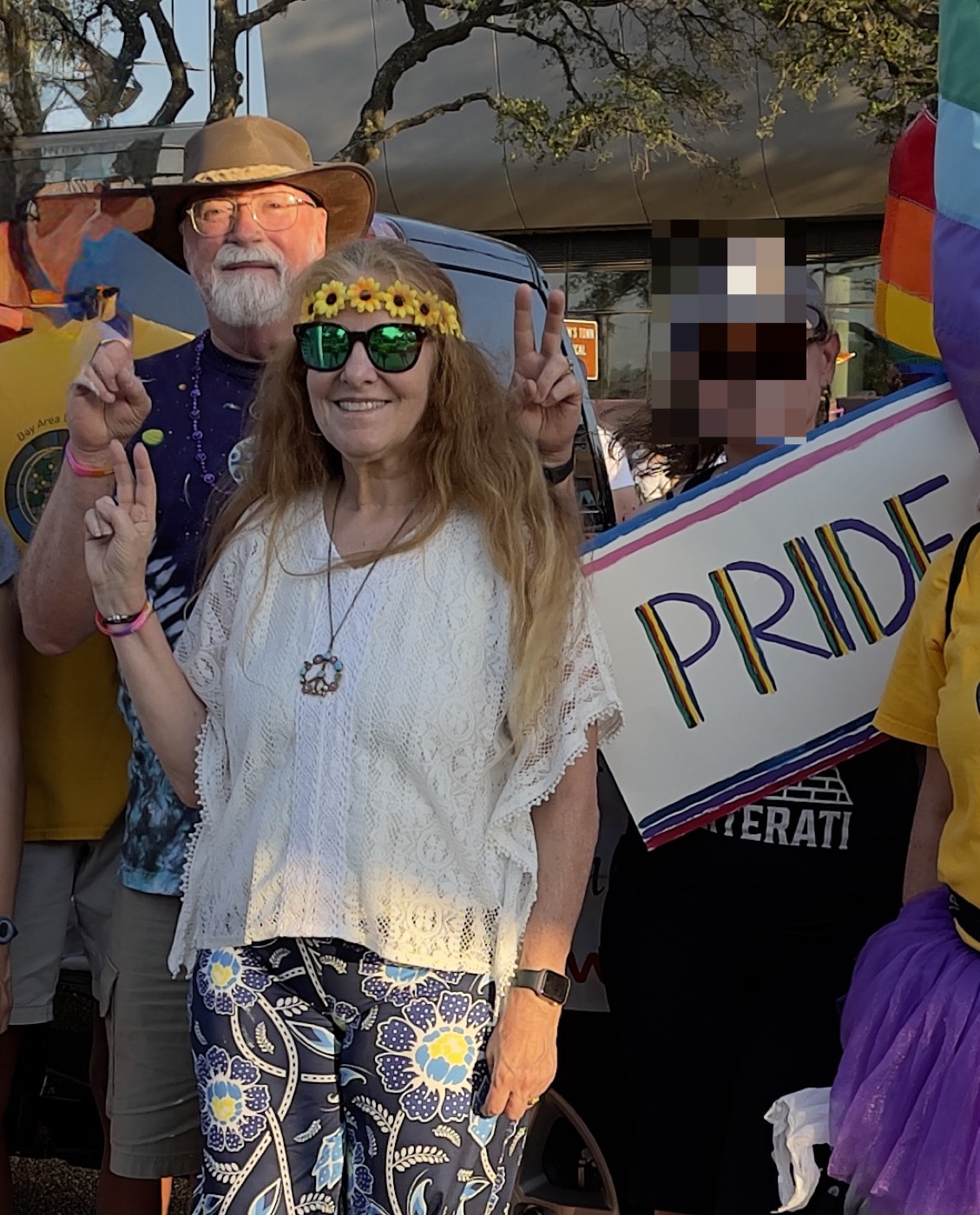
Clif and Terry costumed for “All We Need Is Love” Pride Houston 365 parade, which they have attended devotedly for at least 16 years with Bay Area UU Church.
One of the things I love most about my UU community is that it
has allowed me to serve alongside friends, doing meaningful work
while having fun and building connection at the same time. I am
an active member of my congregation, helping in ways both large
and small — from running PowerPoint during services and
participating in garden clean-up days to serving as a Worship
Associate on Sundays and participating in our ministerial
search team several years ago. I also realize that sometimes
just showing up can be impactful. For this reason, my husband
and I show up at Pride parades (I think we are at 16), events
in support of our neighboring mosque, gun control efforts, and
more.
My husband and I have both been trained as Court Observers and
have attended immigration / deportation court. We have learned
that we can use our privilege, age, and race to help court
processes proceed with dignity and respect. It is actually
amazing to experience what showing up with a badge and a
clipboard can do. The information we capture also helps
Hispanic organizations offer guidance and support to others.
I grew up in a family where service was simply expected. We were
taught to leave every community, organization, and place a
little better for our having been there. When I look at the
lives lived by my three siblings, I know those values stayed
with us and our families.
Terry and Clif as Mrs. Clause and Santa giving to Toys for Tots.
I chaired the development of the Code of Ethics for the
Association of Professional Futurists (APF). Because the APF
includes members from more than sixty countries, the process
required thoughtful collaboration across cultures and
perspectives. We are now developing ethics around the use of
AI in our work. I stay engaged in the field by judging student
awards and recognizing important futures work.
I am very active in local politics, including conducting
candidate interviews and making recommendations during primary
elections. I am passionate about environmental issues, and I was
honored to be trained through Al Gore’s Climate Reality
Project.
Today, much of my energy is focused on civic engagement and
democracy work. I am active in the local No Kings / Indivisible
movement, where a small group of us organized three No Kings
rallies and a Good Trouble event — no small feat in a
Texas suburb. Those efforts helped build the Justice Coalition
of Greater Clear Lake, bringing together organizations including
the League of Women Voters, Democratic groups, Hispanic
community organizations, and a few area churches working
together to strengthen our local community.
Welcome to Texas, y’all.
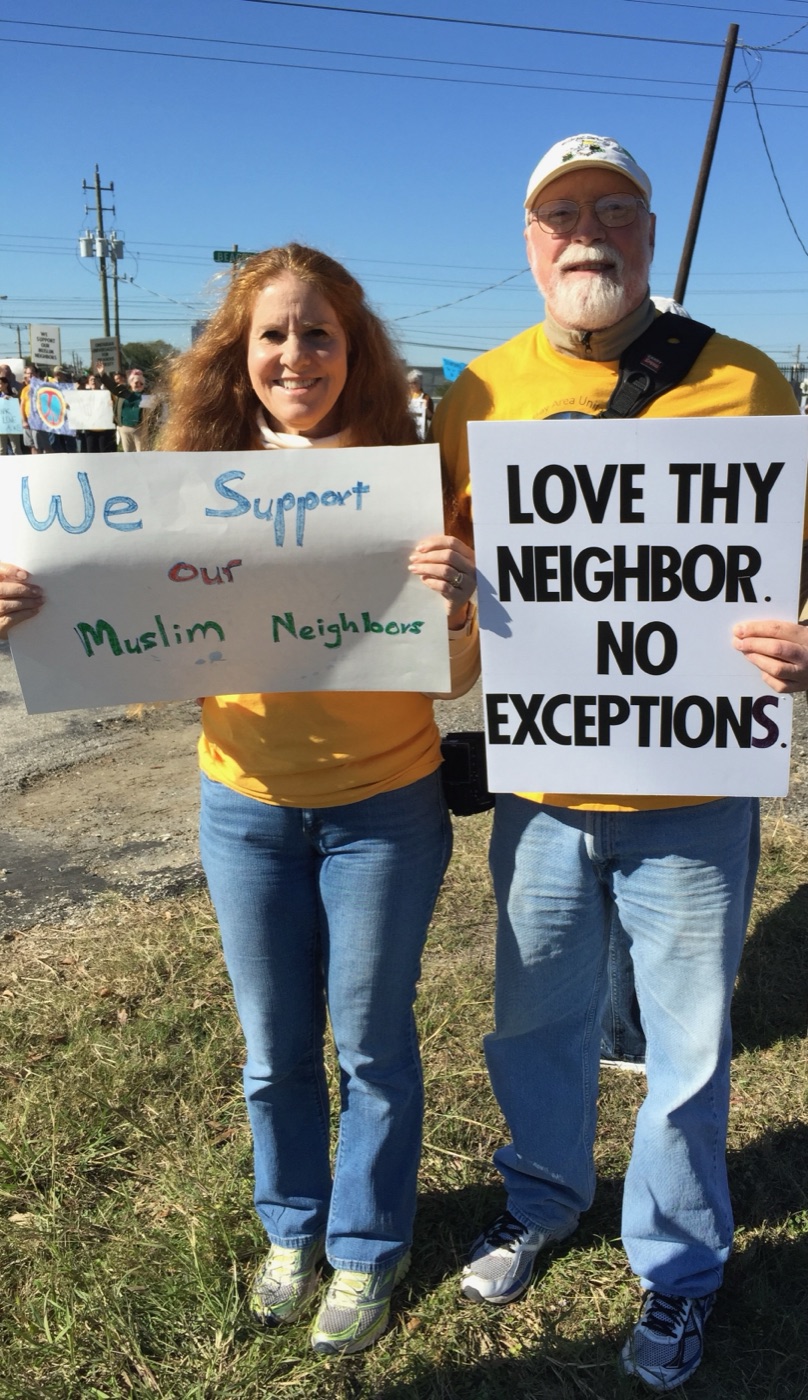
Supporting our Muslim neighbors who have a mosque near our church.
My husband and I transferred to Houston in 1983. We had both
worked on the launch systems for the Space Shuttle in Florida
and transferred with IBM to support the Space Station program.
We were not native Texans, but over four decades later, the
community outside Houston and the Johnson Space Center has
become home.
Texas is a state of contradictions everywhere you look, and
increasingly it is on the front lines of many of the defining
struggles shaping our nation’s future.
Houston is often ranked as one of the most diverse cities in
America. More than 145 languages are spoken across the region,
and the University of Houston’s student body includes
students from more than 137 nations. Houston also elected one of
the nation’s first openly gay mayors of a major city,
Annise Parker. At the same time, Texas has become a national
leader in restrictive legislation around transgender rights,
voting access, and reproductive healthcare.
We are home to the oil and gas industry and one of the energy
capitals of the world. Yet we are also living with some of the
most visible impacts of climate change: stronger hurricanes,
extreme heat, flooding, rising insurance costs, and growing
concerns about coastal resilience.
Texas is experiencing rapid demographic growth and increasing
diversity while also wrestling with polarization over
immigration, public education, LGBTQ+ rights, religion in public
life, and the meaning of democracy itself.
Texas, or parts of Texas, were once part of Mexico, and today
the Hispanic community is deeply woven into our culture,
economy, and identity. Yet ICE visibly patrols some
neighborhoods, and detention centers are rapidly being built.
Our politics are often difficult to understand from the outside.
Governor Greg Abbott represents one of the most conservative
administrations in the country. Yet at the same time, leaders
like State Representative James Talarico, whose language and
vision often resonate deeply with UU values, have inspired many
Texans searching for a different kind of public life.
In many ways, Texas has become a testing ground for the future
of the United States. The forces reshaping America —
demographic change, political polarization, immigration, climate
pressures, religious change, and debates over rights and
identity — are all playing out here in highly visible
ways.
What does this mean for us as Unitarian Universalists? It means
our faith cannot remain abstract. In Texas, our values are
tested in real and immediate ways. We are called to live them
publicly, courageously, and in community with one another.
At Bay Area Unitarian Universalist Church, we have seen our
congregation grow as people search for a spiritual home aligned
with their deepest values. Under the wonderful leadership of
Rev. Katie McQuage-Loukas, our church has become a respected
voice in the broader community. We are using our building, our
resources, and our collective voice not only to care for one
another, but to stand with vulnerable communities and put our
faith into action.
We are still learning how to build diverse, loving, and
resilient communities within this new reality of contradictions.
This is the moment we are called to respond to, and what we are
learning in Texas may have much to offer the larger UU
community.
Future history.
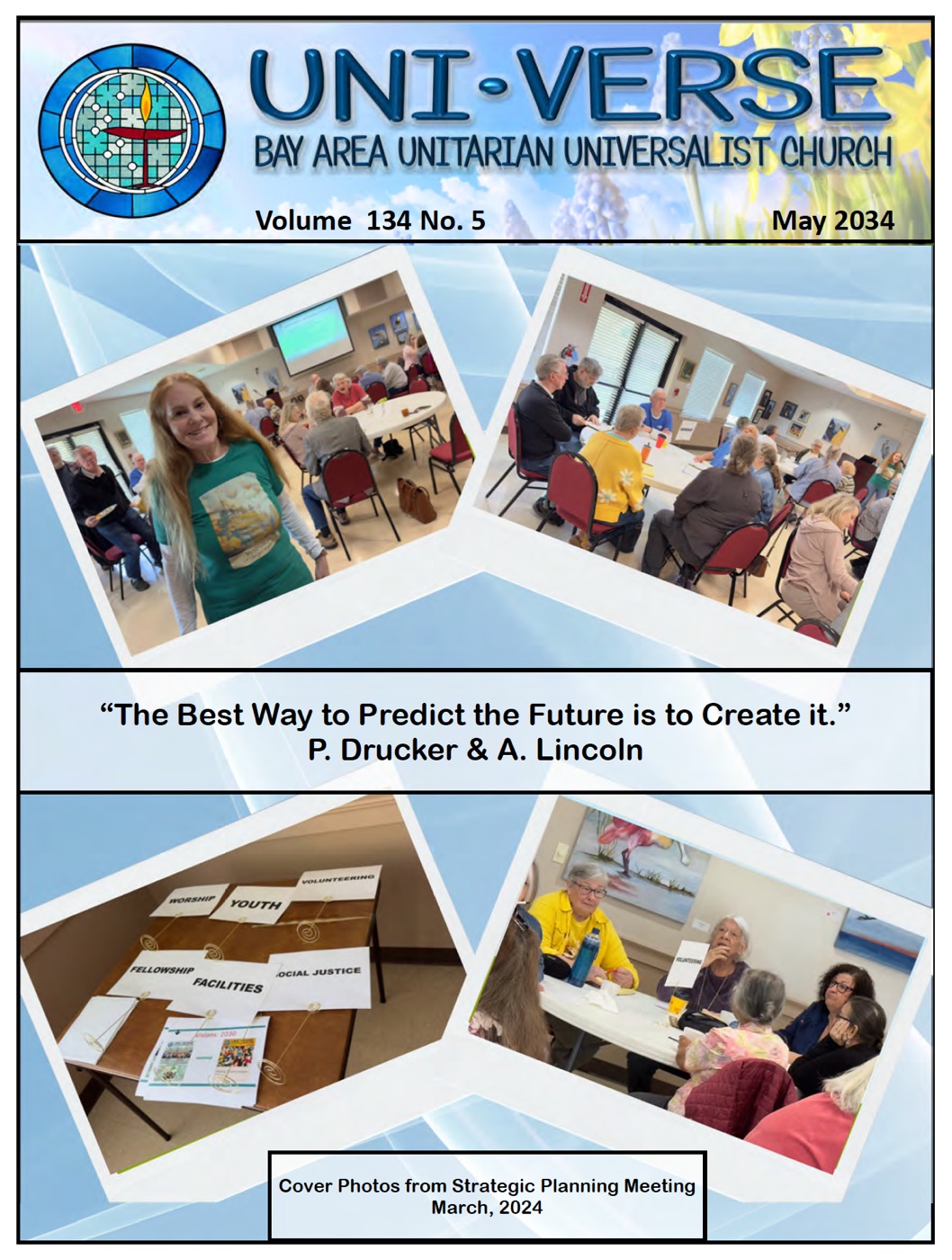
Newsletter reflecting collective future vision of BAUUC in the year 2034.
What stories will future generations tell about this era? Will
they say that Unitarian Universalists showed up with courage,
generosity, imagination, and moral clarity? Will they say we
helped communities stay connected in a time when people were
divided by design? Will they say we defended human dignity not
only in words, but in action?
What does it look like if we start writing our history books of
the future, now?
If we begin by imagining the history we hope others will someday
write about us, then the vision becomes clearer. We can ask
ourselves what kind of movement, what kind of leadership, and
what kind of beloved community would have been necessary to
create that future history. What vision inspires our minds and
our hearts to do this work?
Throughout our history, Unitarian Universalists have often
played a role far larger than our numbers would suggest. Our
congregations and leaders stood alongside movements for
abolition and civil rights, women’s equality, LGBTQ
rights, religious freedom, immigrant justice, and democracy
itself. While we have not always lived fully into our ideals,
we have continually tried to bend toward justice and human
dignity.
What mattered was not simply what we believed, but what we
chose to do when the moment demanded courage.
We are living through another such moment now. Across the
country, many of the values we hold most deeply are being
challenged: pluralism, bodily autonomy, public education,
democratic norms, the rights of LGBTQ people, racial justice,
and compassion for migrants and vulnerable communities. Fear
and division are too often becoming normalized in ways that
should concern all people of faith.
I do not have a singular vision for what our Unitarian
Universalist faith should become, except that it must remain
grounded in our values and in the enduring belief in the worth
and dignity of every person. Because instead of starting with
an answer, we must start with the right questions. It is time
to imagine the future boldly, care deeply for one another, and
act courageously for justice.
And then we can begin building it together.
Support & Connection
If you’d like to support Terry’s campaign, here’s how.
1
If you’re a delegate
Plan to vote at General Assembly 2026 — Terry Grim for
Board of Trustees, Position 5.
2
If you know delegates
Share this site with the credentialed delegates from your
congregation. A short personal note carries real weight.
3
In your congregation
Mention Terry’s candidacy in board meetings,
newsletters, or adult forum conversations about the upcoming
election.
Terry’s approved answers from the 2026 UUA Candidates’
Forum. Choose a section below to read her response.
Introduction
Hello everyone, and thank you for being here tonight. My name is Terry Grim, and my pronouns are she/her. I am a 70-ish white woman with long red hair, wearing a green shirt. I’m deeply honored to have been nominated by the UUA Nominating Committee for this role.
I’m a proud member of Bay Area Unitarian Universalist Church, just outside Houston, Texas. We are a midsize congregation with a strong commitment to social justice in our region, and unlike most congregations, we are growing. Texas has its challenges, but it also offers important opportunities to live our values where they are most needed.
I have been an active UU for 34 years. My life has also been deeply multicultural, having grown up in many different countries, and those experiences formed my strong belief in the dignity and worth of every person and the gift that each person brings.
Professionally, I am a futurist with experience in governance, organizational leadership, ethics, and technology. My work focuses on helping organizations navigate change and think more intentionally about the future. I have served on professional association boards, and I am currently chairing our association’s Code of Ethics development.
We are living through extraordinarily complex times, and I believe we need leaders who can build trust across differences, create settings that bring about our best strategic thinking, and imagine hopeful possibilities.
That’s why I’m running. I believe I have skills that can help the UUA imagine the future boldly, care deeply for one another, and act courageously for justice.
I’m grateful to be part of this conversation tonight.
Why Am I Running?
I’m at a point in my life where I want this next chapter to be about giving back and focusing my energy on things that truly matter. Serving on the UUA Board feels like a meaningful opportunity to bring together two important parts of my life.
My heart comes from Unitarian Universalism. It is where I learned the values of love, dignity, justice, and community. It is where I have seen people show up for one another and for the wider world. It is where I have experienced the power of belonging and the importance of helping people know they are not alone.
My mind comes from futures work. For decades, I have helped organizations think about change, possibility, and the future they hope to create. I have seen how futures thinking can help people become more curious, think more critically and creatively, and make better decisions in the face of uncertainty. I have honestly been thinking this way for so long, it has become my default way of thinking.
In the futures field, my specialty is methodology, helping organizations think about change and possibility in structured and useful ways. One of the models I developed around the maturity of foresight practices received recognition in the field, and I hope to bring that experience and approach to the opportunities and challenges ahead.
What excites me most, however, is not bringing answers. It is helping people ask better questions, learn from one another, and discover possibilities they may not have seen before.
My happy place is working with strong, creative teams. The programs and initiatives coming out of the UUA are wonderful. There are clearly thoughtful and deeply committed people doing this work, and honestly, part of the appeal for me is the opportunity to work alongside them and continue learning and growing myself, being a part of what they’re already doing.
I am running because this feels like a meaningful way to serve a faith that has shaped my life. It is an opportunity to bring together the values I hold most deeply and the skills I have spent a lifetime developing in service to something larger than myself.
How Did I Come to Be Running?
My candidacy began when a member of the nominating committee who was familiar with my professional work in futures and other service within Unitarian Universalism, encouraged me to submit a candidate package. She felt strongly that a futurist belonged on the Board, especially one with global multi-cultural experience in governance, and collaborative, progressive work.
I thought about it for quite a while. What would I need to set aside? What would be required of me? I concluded that it would be an honor, and a meaningful opportunity to use my skills more broadly. So, I said yes.
I found the process thoughtful and thorough. At times it reminded me of those blue-book exams from college. The questions were serious because the responsibility is serious. In my interview, I asked them if I was a fit.
Nominating committees have two important roles in our movement. Their responsibility is not only to identify good individuals, but also to help build an effective board team. We rely on their recommendations because they have considered the context beyond each candidate.
Part of that work is practical: Does the candidate meet the requirements? Are there conflicts or concerns? Are they prepared for the work? Are they willing and able to serve?
But there is another responsibility as well: building a board with a broad range of experiences, perspectives, skills, and representation. A healthy board is not simply a collection of talented individuals. It is a team.
To use a lighthearted metaphor: I felt like a zebra walking into a zoo. I expected them to say, “You are a lovely zebra, but at this moment we already have three zebras and what the team most needs is a giraffe.” That does not diminish the zebra. It reflects the responsibility to build the strongest and most balanced team possible for the work ahead.
Nominating Committee members are elected because we trust them with discernment on behalf of the association. They are elected with the same seriousness as Board members. I have deep respect for that process, for the people who serve in it, and for the trust they place in those they nominate. I am grateful for the trust they placed in me. That trust is what brought me here tonight.
My Vision for the UUA
Ironically, asking a futurist for a vision statement is deeply challenging. A true vision is more than a list of priorities or programs. It must capture hearts and minds. It must express not only our values, but also the unique role we are called to play in the world.
A strong vision helps people see themselves in a shared future. It guides strategy and decision-making. It helps us determine not only what we should do, but also what we should say no to.
Dr. Martin Luther King Jr.’s “I Have a Dream” speech remains one of the most powerful visions I know because it was both aspirational and concrete. He didn’t just describe his values, he painted a future people could see themselves helping to create. I still listen to it at least every year.
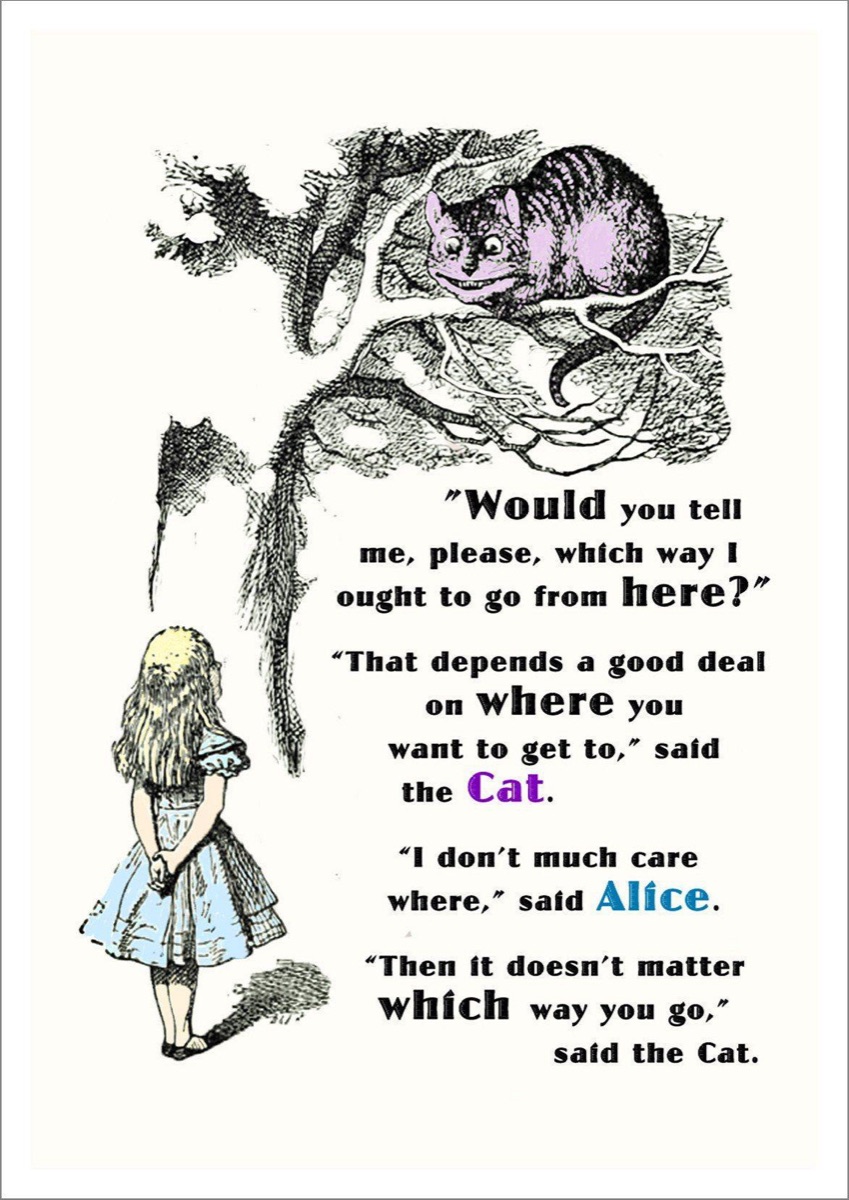
Alice and the Cheshire Cat — John Tenniel’s illustration for Lewis Carroll’s Alice’s Adventures in Wonderland.
Like Alice asking the Cheshire Cat which way to go, we first have to know where we hope to end up before we can choose the path that will take us there.
I believe meaningful vision does not come from wishful thinking, but emerges through open dialogue and shared stories. It builds on the strengths we already have, moments when we are most proud of who we are. The best of who we are today becomes the foundation for tomorrow.
I am most proud of who we are when we are driven by our values with love at the center. We show up. We show up in support at Pride parades, NAMI walks, and Black Lives Matter events. We show up to help clean up after hurricanes, and to food drives. We keep showing up to advocate for democracy and justice. We stand publicly for love, dignity, and belonging.
We show up based on where we are. Our church is down the street from an Islamic mosque and community center. After the shootings in San Diego last month, members stood with signs expressing our love and support for our Muslim neighbors. We make sure they know they are not alone.
I recently attended a workshop on building resiliency centers, and connected with Community Church UU in New Orleans. They have about sixty members and managed to create a resiliency center that serves as a model for other communities. This is happening all over the country, and it is not an isolated example. It is who we are and who we are becoming.
My vision for the UUA is that we continue being a courageous, forward-looking faith movement, grounded in our values and confident in who we already are at our core.
Unitarian Universalism has something important to offer a fragmented and uncertain world. We begin with the inherent worth and dignity of every person. We practice respect across difference. We know that communities are stronger when people are heard, trusted, and valued.
I believe the UUA can help our congregations do more than survive change. We can help them lead through it. Not by pretending these times are easy, but by remembering what we know how to do. We know how to gather. We know how to listen. We know how to cooperate, collaborate, and create vision together. We know how to keep showing up.
These are difficult times, but they are also times of possibility. When old systems fracture, people begin searching for new ways to belong, to relate, and to build community. That is where Unitarian Universalism can offer something real: connection rooted in dignity, courage grounded in respect, and a way forward shaped by shared purpose.
In my professional work, I have often helped organizations create what we call future histories, stories told from the perspective of a future we hope to build. These stories make vision tangible. They help people see themselves as part of something larger than the present moment, and understand the role they can play in bringing that future into being.
Again and again, the stories of our faith show us who we are when we are at our best. UUs show up. We help people know they matter. We help people know they are not alone. We build communities where dignity is honored, differences can coexist, trust can grow, and people work together for the common good.
My hope is that the UUA becomes even better at connecting these stories, learning from them, and sharing what we have learned. Like OWL, we have practices and values that reach beyond our congregations because the world needs them.
We do not need to begin with all the answers. We need to begin with trust in one another, confidence in our values, and the courage to imagine the future together.
And then, together, we can build it.
What I Bring to the Board
What I bring to the UUA Board is a combination of strategic foresight, collaborative leadership, practical experience helping organizations navigate complexity and change.
The work of a futurist is not about predicting the future. We don’t even use the word as a singular “future”. We use the plural “futures”. It’s about helping people make better decisions.
As an experienced professional futurist and organizational consultant, I have spent decades giving communities the tools to ask better questions, think systemically, and prepare thoughtfully for an uncertain future. Throughout my career advising organizations, corporations, government officials, and a broad range of nonprofits, I have endeavored to help people recognize emerging challenges, explore possibilities, and make values-based decisions in times of rapid change.
I bring extensive leadership and governance experience. Within my congregation, I have served in a wide range of leadership roles over more than three decades, including President, Vice President, Treasurer, Director, Worship Associate, Social Justice Chair, mentor, and whatever else needs doing, including pressing buttons for the Power Point presentation during Sunday Service. I understand the practical as well as strategic reality of sustaining healthy institutions.
My specialty is creating a constructive, inclusive environment where diverse voices are heard. I believe creativity, wisdom, and stronger solutions emerge when people build plans together around shared goals.
I believe leadership is not about having all the answers. Leadership is about helping people discover the answers together. I can do the research, but the best ideas emerge from the group. It is about helping communities think clearly, build trust, and move forward with purpose and compassion. Leadership must listen and include, to inspire collective, meaningful action.
People must feel valued if groups are to work through complex challenges together. We maintain respect at all times. We listen to all stakeholders in purposeful engagement, and only then do we create a plan of action together that moves us toward collective goals.
I also bring a perspective from Texas and The Southern U.S. that is sometimes underrepresented in national UU leadership. Living in Texas, demonstrating and organizing to defend our principles, has taught me resilience, adaptability, coalition-building, and the importance of living our values visibly, publicly, and unapologetically. It’s not for the faint of heart. Sometimes the setting is challenging or even hostile, but fighting alongside each other bridges our differences and strengthens our bonds.
Most importantly, I bring a deep love for Unitarian Universalist values and a belief that our faith has an important role to play in this moment in history. I believe the UUA needs leaders who can help us remain grounded in our values while also preparing thoughtfully for the future that is emerging around us.
That is the work I feel called to do, and where I believe I can make the greatest contribution.
Closing Statement
I didn’t take the traditional route to this nomination, and I don’t have the same background as many who have served on the board before. But I do bring more than thirty years of helping organizations imagine what comes next and navigate change. And a deep belief that our faith offers something the world needs right now. I bring a skill set that complements the strengths already on the board.
This seems like a good time to tell you my UU story. Thirty-four years ago, I came to Bay Area UU Church because I was asked to facilitate a visioning exercise. I had never heard of Unitarian Universalism before then, and I was unchurched. But the members shared their hopes for the future, and created a vision that I wanted to be part of. I didn’t just admire it — I could see myself in it and I wanted help. So I joined them in building it. And I am still here.
This is not an easy moment for our faith or for our world. But difficult moments are when vision matters, when compassion matters, and when courageous leadership matters most. This moment calls for us to imagine the future boldly, not with fear, but with hope and purpose. This moment calls us to care deeply for one another, especially when it is difficult. And we must act courageously for justice, showing up over and over.
Service has always been my prayer. Helping people create a better future has been the work of my life. I would be honored to bring that commitment to the UUA Board, and help build that future together.